© Werner Hammerstingl, 2000, 2005
Semiotics or Semiology as the French prefer to call it is a study of signs. It deals with all processes of information interchange as far as signs are involved. Human beings talk, write, sing, smell and gesture. We erect signs or barriers to communicate messages to other people. We constantly produce and interpret signs and codes. But even if no-one intends to communicate
anything, sign processes are continuously taking place: A doctor interprets the symptoms of a disease, a dog follows a trail, a thief triggers an alarm. Semiotics explores all such processes with regard to common structures. Its scope reaches far beyond the area of cultural phenomena and involves the interaction of
animals, the activity of orientation and perception of all living things, the stimulus and response processes of animals and plants and even the metabolism of organisms and
information processes by machines. The scientific disciplines concerned with different aspects of culture(s) (linguistics, literary science, musicology, art history, archeology,
history, sociology, political science, religious studies etc.) and nature (chemistry, biology, physics etc.) are integrated in semiotics by exploring the sign character of the
natural and cultural phenomena examined. It describes the various sign phenomena (Descriptive Semiotics), systematizes them in theories and models (Theoretic Semiotics), and attempts to apply this knowledge in
helping to find solutions to problems in science, society, commerce, and in everyday life (Applied Semiotics).
Saussure might be termed the founder of semiotics, the discipline has become less and less Saussurean in recent years (i.e. less structuralist).
Semiosis (The production of meaning) is a term borrowed from Charles Sanders Peirce and expanded by Umberto Eco to mean a process by which a culture produces signs and/or attributes meanings to signs.
For Eco the production of meaning (Semiosis ) is a social activity. This allows for subjective factors to intrude in each individual act of Semiosis.
Communication theory It might be said that semiotics belongs under the greater umbrella of Communication theory. Some of the important work in this field dates back more than half a century such as the work by Shannon and Weaver.
Shannon and Weaver's "linear model"of 1949
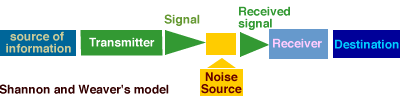
Shannon and Weaver identify three levels of problems in communication .
Level A
(Technical problems)
• How accurately can the symbols of communication be transmittes?
Level B
(semantic problems)
• How precisely do the transmitted symbols convey the desired meaning?
Level C
(effectiveness problems)
• How effectively does the received meaning affect conduct in the desired way?
 This is the decision maker that thecides on the message to
be sent. It is one from a set of possible messages.
This is the decision maker that thecides on the message to
be sent. It is one from a set of possible messages. 
A signal is the physical form of a message: sound or airwaves, electrical pulses, a touch etc.
 Anything
that's added to the signal between its transmission and reception that's
not intended by the source.
Anything
that's added to the signal between its transmission and reception that's
not intended by the source. 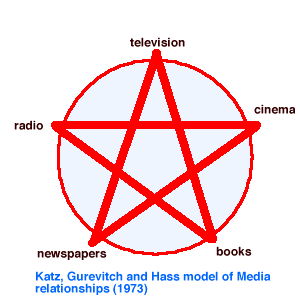
According to these researchers who studied why people turn to a particular medium in a large scale audience survey , the better educated tended to turn to print media whereas the less educated tended to use more electronic media.
The audience tended to agree that each medium was most similar to it's neighbours (on this model)
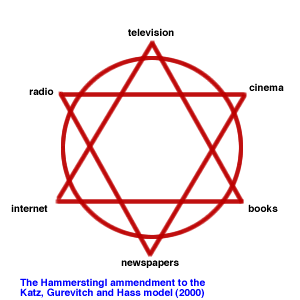
The updated model which includes the internet in what the writer considers the appropriate position
sign A sign stands for something to the idea which it produces or modifies....That for which it stands is called its object, that which it conveys, its meaning; and
the idea which it gives rise, its interpretant....[the sign creates in the mind] an equivalent sign, or perhaps a more developed sign. That sign which it creates I
call the interpretant of the first sign. This sign stands for something, its object. It stands for that object, not in all respects, but in reference to a sort of idea
which I have sometimes called the ground of that representation." C. S. Peirce, quoted in Umberto Eco (1979) The Role of the Reader 7.2. A semiotic model:
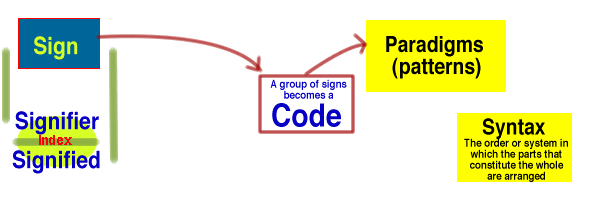
The Index/Indexical is a mode in which the signifier is directly connected in some way (physically or causally) to the signified. This link can be inferred or observed (e.g. smoke, thermometer, clock, spirit-level, foot or fingerprint, knock on door, pulse rate, sunburn, pain etc).
Peirce makes an even finer distinction in this model which allows for differentiation between:
- icon (Meaning based on similarity of appearance)
- index(Meaning based on cause and effect relationships) and
- symbol(meaning
based on convention)
signifier The vehicle which conveys the signified. (In sausurean semiotics i.e. linguistics, it would be the sound image). Saussure for example demonstrated that whilst the signifier and signified together constitute a sign, the relationship between signifier and signified is rather arbitary. For instance: in a particular configuration, the letters "E", "D" and "R" will form the sequence "R", "E", "D". RED denotes a certain colour, but neither the letters individually nor their formal combination into a word have anything to do with redness.
This insight has had a powerful imoact on "postmodern thought" since all meaning is supposedly founded on convention, it is subject of critique on the basis of guilt by association. For example: the most widely accepted meaning of a disputed term could be dependent on the supression of its use amongst a marginal group.
signified The idea or meaning expressed by a particular signifier
code
The human body is the main transmitter of presentational codes (Fiske, 1990, p.68 listing Argyle, 1972).
A list of the following 10 codes suggests the sorts of meaning they can convey:1. Bodily contact
Whom we touch, where and when we touch communicates a great deal about relationships. This code and the next appear to have the greatest degree of cultural variations. the British are the least "touchy" race.
2. Proximity (proxemics)Physical distances are highly codified and vary between social class and nationality of the participants. Generally less than one meter is "intimate" one to 3 meters personal and beyond that, semi-public.
3. OrientationHow we angle our bodies to others is another way of signalling a message. Facing another person tends to signify either intimacy aor agressiveness. Angular positions up to 90 degrees indicates co-operative attitude.
4. Appearancea Aspects under voluntary control
5. Head nodsIncludes hair, clothes, skin, body paint and adournment incl. make-up
b Aspects not under voluntary controlHeight, weight etc.
Mainly involved in interaction management such as turn-taking in conversation. One nod may be a silent parmission for the speaker to continue. A serious of rapid nods may be a pre-emptive gesture indicating the wish to speak or break into the conversation of others.
6. Facial expressionConsists of a range of sub-codes of eye-brow position, eye shape, mouth shape, nostril size and so on. These in combination determine the expression of the face and what it's "grammar" signifies. Facial expression is the most cross-culturally stable of all presentational codes.
7. gestures (Kinescics)While hand and arm are the most efficiant transmitters of kinesic information, the feet and head position arte also important.
8. PostureThe way we sit stand etc can communicate a limited but interesting range of meanings. Often they signify interpersomnal attitudes such as friendlyness, hostility, flirtatiousness, superiority etc.
9. Eye movement and eye contact
Posture can also indicate if we're relaxed or tense. The posture often gives away more than the face as it seems less consciouly controlled.When, how often and for how long we meet other peoples eyes is a way of sending very important messages about relationships. Indicating for example how afiliative or dominant we wish the relationship to be. Usually the making of eye contact at the beginning of a statement indicated a desire to dominate the listener but eye contact at the end of a statement suggests a more affiliative relationship, a desire for feedback.
10. Non verbal aspects of speech.a. Prosodic codes affect the meaning of words used. Pitch and stress are the main codes here. How was that? can be made int a statement, a question, or an exclamation of disbelief depending on the pitch of the voice.
b. Paralinguistic codes communicate information about the speaker. Tone, volume, accent,speech errors and speed of speach communicat something about the speakers emotional state, their personality, educational background, class and social status, perception of the listener and so on.
paradigm An example, pattern or standard. In grammar, a paradigm is the set of inflected forms of a word -- e.g., "artist, artist's, artists, artists'" -- or the standard pattern followed in the conjugation of a verb -- first person singular, second person singular, third person singular, first person plural, second person plural, third person plural. 2. By extension, the term also refers to the basic structure of given mind-sets or models of knowledge, as in paradigm shift. Saussurean semiotics has developed the notion that every sign is part of a system of relationships with other signs structured through similarity and difference. These systems are called paradigms. A word thus has a paradigmatic relationship with its own inflections, new words established through prefixes and suffixes, synonyms and antonyms, etc. The "paradigmatic axis" is a field of possible substitutions of one word for another, developed by Roman Jakobson into what he called a selection relation. In film studies, a paradigmatic axis refers more simply to a single shot or view of something (see mise-en-sc�ne) rather than to a succession of images, so that a metaphor, for example, in a paradigmatic axis is one which emerges in an individual shot, rather than in a sequence of shots (which would be its syntagmatic axis).
paradigm shift Established, largely unconscious habits of mind, like faith in scientific progress in the modern era or the divine right of kings in the mediaeval era, can be considered paradigms. When one era shifts into another, the old habits are disrupted by new ones which eventually settle into a familiar routine. The phrase derives from Thomas Kuhn, who wrote about changes in the history and philosophy of science, but it is now a commonplace used to describe any sort of major shift of mind-set or perspective. For example, the change from pre-modern to modern art was effectively a change from the so-called "window paradigm" -- the idea of a painting as a hole in the wall through which one saw beyond the room, as in Renaissance and Baroque illusionism -- to a new paradigm of abstraction.
Similarly, the change from modernism to postmodernism is now commonly called a paradigm shift. More concepts: This link takes you to a page that further explains some concepts that relate to the deconstruction of and image in semiotic analysis. click here
links The Okanagan University College has a site called WORDS OF ART where pretty well every term you're likely to encounter in art and/or semiotic theory can be looked up from a well organised alphabeticised index.
The University of Colorado in Denver has this Meta index on semiotics resources.